
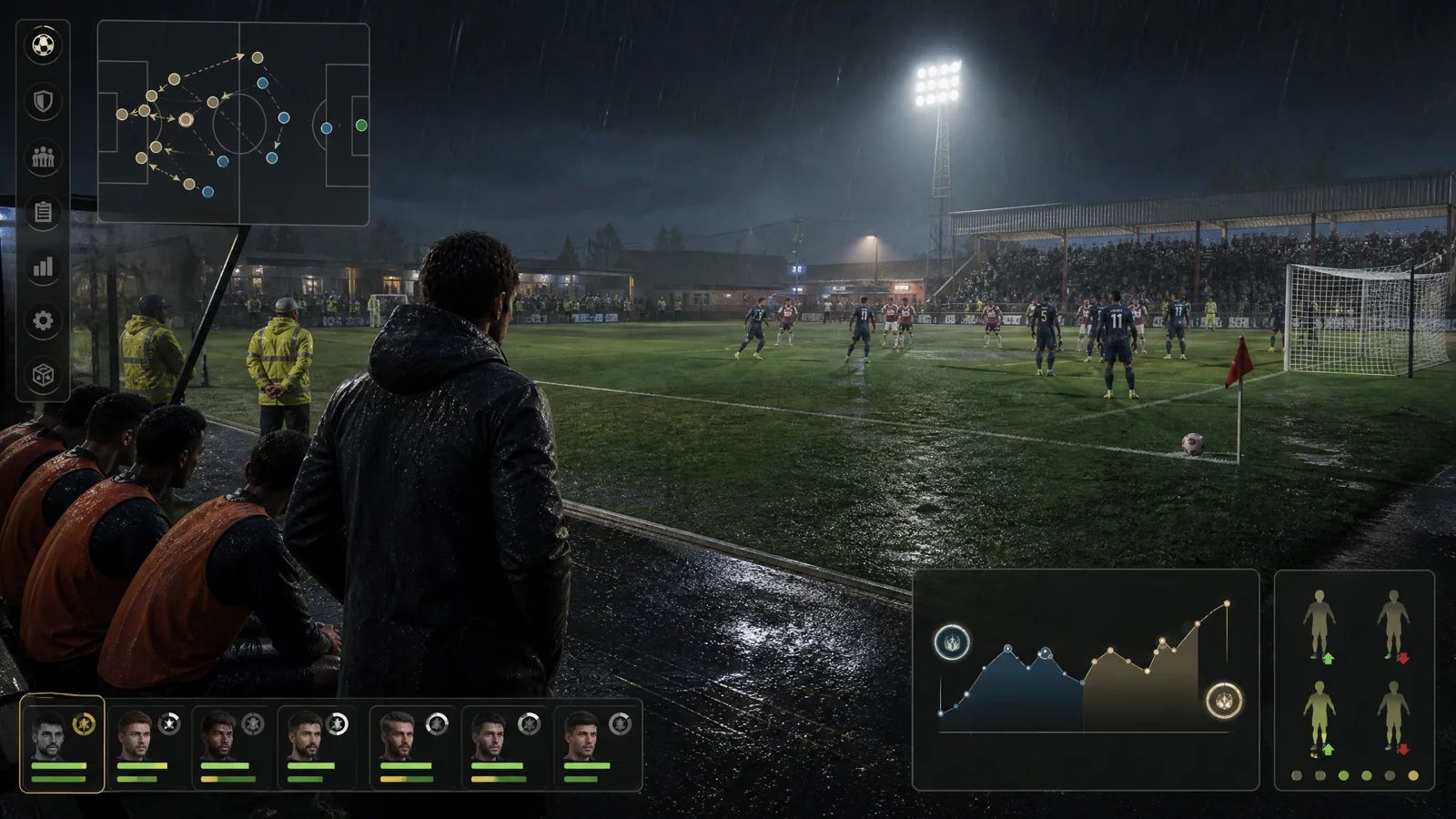
There is a moment in every match when the rain begins to lash against the dugout roof, the floodlights flicker into life, and you realise that your meticulous pre-match preparation means absolutely nothing if your midfield cannot hold their shape on a waterlogged pitch.
The Mud and the Rain
Football management simulators have long been defined by their abstraction. We are accustomed to sitting behind virtual mahogany desks, clicking through endless spreadsheets, negotiating contracts, and occasionally glancing at a match engine that feels entirely disconnected from our input. After the Floodlights takes a radically different approach. It pulls you out of the boardroom and shoves you firmly into the technical area, demanding that you manage the match as it unfolds in front of you. This is a game about the ninety minutes of football, the rain-soaked lower-league pitches, and the frantic touchline instructions that can turn a match on its head.
The visual presentation immediately establishes this focus. There are no menus filled with attributes graded out of twenty. Instead, you observe the match from a dynamic touchline perspective. The rain is a constant companion in the early stages of the season, turning the pitch into a heavy, unforgiving surface. Your players trudge through the mud, their kits becoming progressively dirtier. When you call up the tactical overlay, it does not pause the action. A sleek, minimalist interface projects onto the pitch itself, highlighting your team's shape, the distances between defenders, and the zones where the opposition is finding space.
Maintaining the Shape
At the core of After the Floodlights is the concept of shape. You are not micromanaging individual passes; you are managing the collective movement of your team. The game relies on a sophisticated physics and momentum engine, where the physical condition of your players directly impacts their ability to maintain the tactical structure you have drilled into them. As the pitch deteriorates and fatigue sets in, the rigid 4-4-2 you started with might begin to look more like a desperate, sprawling mess. Your central midfielders will struggle to track back, leaving gaping holes for the opposition to exploit.
This is where your touchline instructions become crucial. You have a limited number of 'shouts' available to you, representing your ability to cut through the noise of the crowd. You can demand that the defensive line pushes higher, instruct your wingers to tuck inside, or simply demand more aggression in the tackle. However, these instructions are not magical buffs. They are interpreted by the players based on their current condition, their understanding of your system, and the overall momentum of the match.
The feedback you receive is delightfully organic. You do not get a percentage indicating a player's stamina. Instead, you must watch their body language. A striker who is blowing hard and walking back onside is clearly struggling. A full-back who is consistently caught out of position might be suffering from a knock. This limited information forces you to be observant and decisive.
The Art of the Substitution
Because the physical toll of the match is so pronounced, substitutions in After the Floodlights are not merely a way to give fringe players some minutes; they are your most potent tactical weapon. Bringing on a fresh pair of legs can completely alter the dynamic of a game, particularly in the latter stages when the pitch is heavy and both teams are running on empty. You can see your substitutes warming up on the touchline, their presence a constant reminder of the options at your disposal.
When you make a change, the impact is immediate and palpable. A quick, energetic winger introduced against a tiring full-back can instantly shift the momentum in your favour. The game models momentum beautifully, treating it as a tangible force on the pitch. When your team is in the ascendancy, passes seem to find their targets more easily, tackles are won with more conviction, and the crowd noise swells. Conversely, when the opposition has you pinned back, the atmosphere becomes tense, the sound of the rain seems louder, and every clearance feels desperate.
Dead Ball Situations
Set pieces are another area where the game excels in its focus on the physical reality of the match. You do not design intricate routines on a chalkboard. Instead, you assign roles based on the attributes you have observed in your players. When a corner is awarded, the camera shifts slightly, heightening the tension. You can issue last-second instructions, perhaps telling your central defender to attack the near post or asking your holding midfielder to hover on the edge of the box.
The physics engine truly shines in these moments. The trajectory of the ball, the jostling in the penalty area, and the unpredictable nature of the ricochet all feel incredibly authentic. A well-delivered free-kick that skims off the wet turf and evades the goalkeeper is immensely satisfying, while conceding a scrappy goal from a corner you failed to defend properly is agonising.
- Tactical overlays project directly onto the pitch, maintaining immersion.
- Player condition is communicated through body language and movement.
- Momentum shifts are palpable, affecting both team performance and audio design.
- Set pieces rely on physical positioning and real-time instructions.
The Boundaries of the Dugout
While After the Floodlights succeeds brilliantly in its core objective, its intense focus on the ninety minutes does come with some limitations. By stripping away the broader aspects of football management, the game can occasionally feel slightly narrow in its scope. There is no transfer market to scour, no youth academy to develop, and no media narratives to navigate. Your entire existence is confined to the matchday experience. For those who enjoy the long-term squad building of traditional simulators, this singular focus might feel restrictive.
Furthermore, the reliance on visual cues for player condition can sometimes be frustratingly opaque. While it is generally effective, there are moments when a player's sudden drop in performance feels unexplained.
Final Judgement
After the Floodlights is a bold and necessary corrective to the increasingly bloated nature of football management simulators. It strips away the spreadsheets and the boardroom politics, leaving only the raw, visceral experience of managing a football match from the touchline. The rain, the mud, the tactical shape, and the desperate shouts into the wind all combine to create an experience that is both exhausting and exhilarating. It demands your full attention, forcing you to read the game as it happens and make decisive interventions based on limited, organic information.
It is not a game that will appeal to everyone. Those who crave the God-like control and statistical depth of its competitors will find it lacking. But for those who have ever stood on the touchline of a Sunday league pitch, watching their team lose their shape in the driving rain, this game captures the essence of football management better than anything else on the market.