
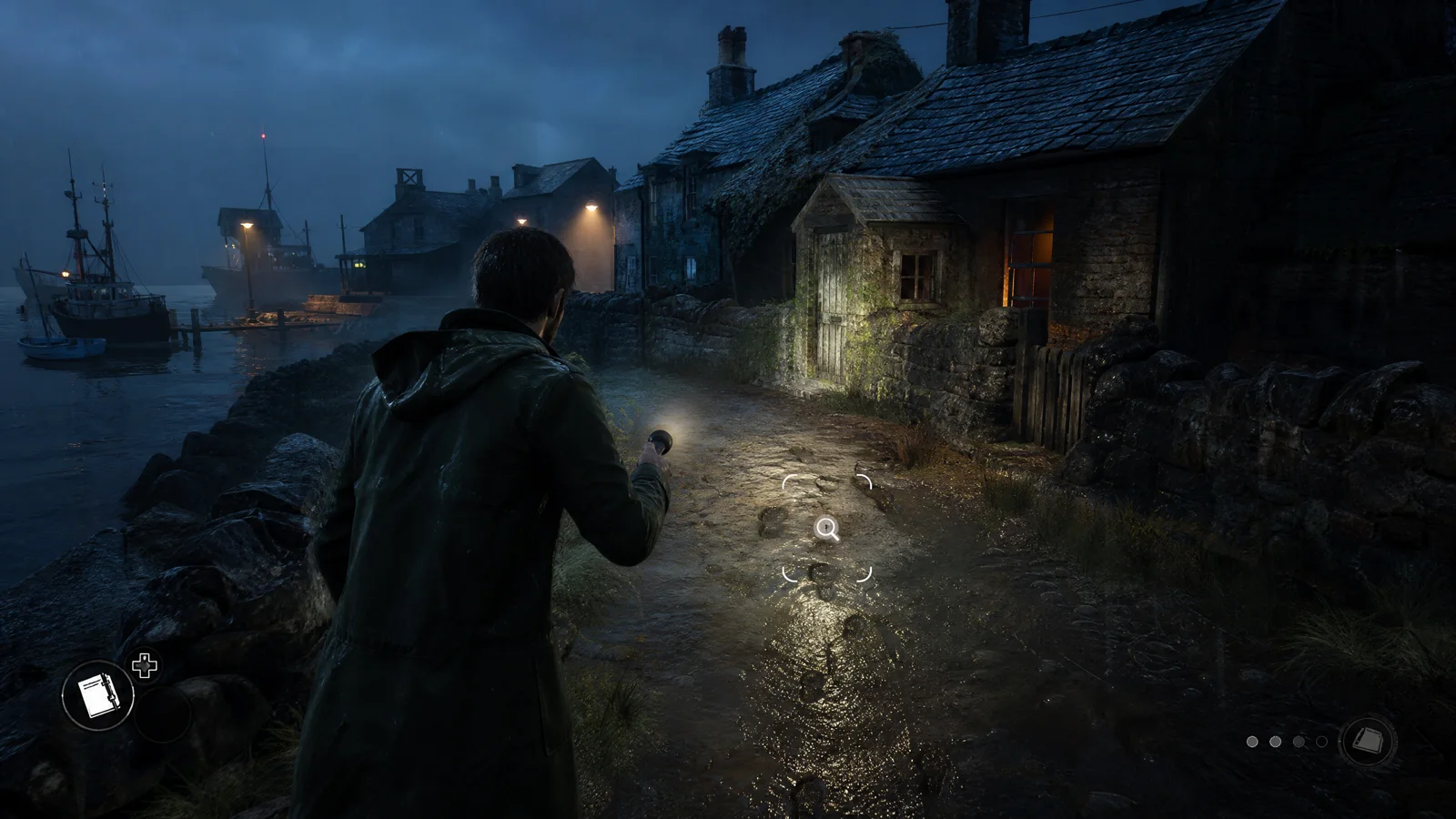
There is a moment in Lantern County, roughly four hours into its sodden, meticulous campaign, where the true nature of the game reveals itself not through a dramatic plot twist, but through the mundane act of checking a tide timetable. You are standing in a downpour, your torch beam cutting weakly through the coastal gloom, waiting for the water to recede so you can examine a stretch of muddy shingle. It is here that you realise this is not a game about cinematic heroics or rapid-fire deduction. It is a game about patience, routine, and the quiet satisfaction of piecing together a community’s secrets one damp receipt at a time.
A Village Washed in Grey
Developed with an acute understanding of British coastal melancholy, Lantern County casts you as a private investigator summoned to a seemingly unremarkable seaside village. The visual direction is striking in its commitment to the mundane. The game engine renders the environment in muted greys, bruised purples, and the slick, oily sheen of wet tarmac. When your third-person protagonist, clad in a suitably practical green waterproof coat, crouches to examine a set of muddy footprints outside an abandoned harbour cottage, the scene feels palpably damp. The rain here is not merely an aesthetic overlay; it is a physical presence that dictates the rhythm of your investigation.
This commitment to atmosphere extends to the audio design, which is a masterclass in understated tension. There is no swelling orchestral score to telegraph danger. Instead, your constant companions are the rhythmic drumming of rain against your hood, the distant cry of gulls, and the crunch of shingle underfoot. The wind howls through the narrow alleys between pebble-dashed houses, occasionally rattling a loose window frame. It is an isolating, deeply immersive soundscape that grounds you firmly in the reality of this forgotten corner of the country.
The Weight of the Notebook
The core gameplay loop of Lantern County eschews the streamlined, automated detective work found in many contemporary titles. There is no magical vision mode that highlights clues in glowing neon. Instead, you are armed with a restrictive evidence reticle, a torch with a finite battery life, and a notebook that demands your active participation. When you discover a point of interest—a discarded ferry ticket, a scuffed skirting board, or a curiously arranged set of fishing floats—you must manually link these observations within your notebook to form hypotheses.
This system requires genuine cognitive effort. The game does not hold your hand or connect the dots for you. You must carefully parse the information you gather, considering not just what an object is, but where it was found and when. The necessity of managing your torch battery adds a layer of practical tension to your exploration. Venturing into the pitch-black basement of a derelict pub becomes a calculated risk, forcing you to memorise room layouts and prioritize which corners to illuminate before your light inevitably flickers and dies.
Dialogue as a Tactical Exercise
Interrogating the locals is just as demanding as scouring the environment. The residents of Lantern County are fiercely protective of their own, and they do not surrender information easily. Conversations are presented not as simple dialogue trees, but as tactical exchanges where your tone and the evidence you choose to present can permanently alter a character's disposition towards you. Pushing too hard on a sensitive subject without sufficient proof will cause a suspect to clam up, potentially locking you out of crucial testimony.
The writing shines in these encounters, capturing the specific cadences and guarded politeness of rural British life. Characters speak in half-truths and deflections, requiring you to read between the lines and cross-reference their statements against your physical findings. It is deeply satisfying to return to a previously uncooperative publican armed with a damning piece of correspondence, watching their carefully constructed alibi crumble under the weight of undeniable, documented fact.
Ruled by the Elements
Perhaps the most innovative system in Lantern County is its integration of time and weather. The village is not a static diorama; it is a living space governed by the shifting of the tides and the unpredictable coastal climate. Certain areas, like the sea caves beneath the cliffs or the mudflats near the estuary, are only accessible during low tide. You must consult a tide schedule, found pinned to the noticeboard in the harbourmaster's office, to plan your excursions.
Furthermore, revisiting streets after weather changes often yields new discoveries. A heavy downpour might wash away loose topsoil to reveal a buried item, while a sudden drop in temperature can cause frost to highlight previously invisible tracks. This dynamic environment encourages constant backtracking, transforming the village into a complex puzzle box that slowly unfolds over the course of the game.
- Evidence Reticle: Requires precise positioning rather than sweeping area scans.
- Notebook Links: Manual deduction system forcing players to understand connections.
- Tide Schedule: A pacing mechanism dictating when and where you can explore.
- Weather Variations: Transforms locations and reveals clues based on environmental shifts.
The Cost of Authenticity
For all its brilliance, Lantern County's uncompromising dedication to realism occasionally crosses the line from immersive to frustrating. The deliberate pacing will undoubtedly alienate players accustomed to a brisker tempo. Walking from one end of the village to the other takes time, and there is no fast-travel system to alleviate the repetition of traversing the same rain-slicked streets. When you realise you have left a crucial piece of evidence on the other side of town, the prospect of the return journey can feel like a chore.
Additionally, the manual notebook system can sometimes be overly pedantic. There are moments when you have clearly deduced the correct sequence of events in your head, but the game refuses to acknowledge your conclusion because you have not linked the specific, arbitrarily correct combination of notes. This friction, while authentic to the messy reality of detective work, can disrupt the flow of an otherwise engrossing investigation.
A Quiet Triumph
Despite these minor grievances, Lantern County stands as a remarkable achievement in the detective genre. It bravely discards the bombast and spectacle that often characterize video game mysteries, opting instead for a grounded, methodical approach that respects the player's intelligence. It understands that true detective work is not about sudden flashes of genius, but about the slow, steady accumulation of facts, the tedious cross-referencing of statements, and the willingness to stand in the freezing rain until the tide goes out.
By making the routine feel significant and the modest clues feel monumental, the developers have crafted an experience that lingers in the mind long after the final case is closed. Lantern County is a bleak, beautiful, and demanding game that proves you do not need a world-ending conspiracy to tell a compelling story. Sometimes, all you need is a village that keeps its receipts, and a detective stubborn enough to read them all.