
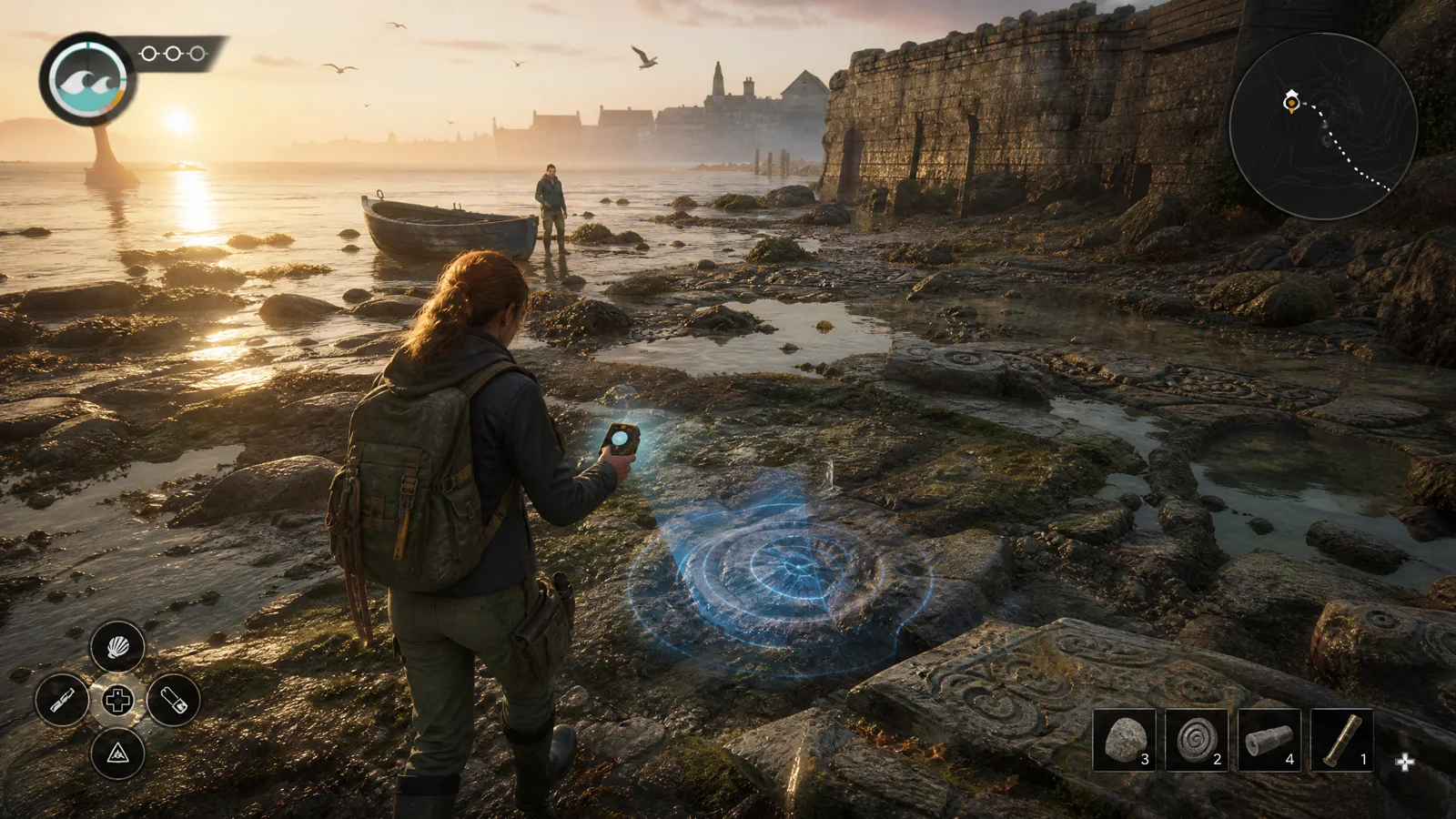
The sea does not wait for marine archaeologists, nor does it care for the delicate carved stones left exposed on the mudflats. In Low Tide Stories, the rhythm of the ocean dictates everything. It is a game where time pressure is not a punishing mechanic, but a gentle, inevitable force that encourages careful observation over frantic rushing. You are given a window of hours to explore, scan, and catalogue the ruins of a forgotten coastal civilisation before the tide reclaims them.
The Ebb and Flow
At its core, Low Tide Stories is a third-person exploration game built around a singular, defining constraint: the tide timer. Unlike traditional countdowns that induce panic, the rising water here feels like a natural breathing of the world. From your vantage point on the muddy shores, you can see the water slowly creeping up the carved monolithic stones and ancient pathways. The game divides your expeditions into tidal cycles. When the water recedes, you disembark from your companion boat—a sturdy, weathered vessel that serves as your mobile base of operations and sanctuary. The exposed tidal ruins are vast, slippery, and labyrinthine. Route planning becomes essential. You must chart a path through the waterlogged trenches and algae-covered terraces, knowing that certain avenues will be cut off in a matter of minutes. The brilliance of this system lies in its transparency. A subtle watermark on the UI and the changing ambient soundscape of lapping waves provide constant, organic feedback about the encroaching sea. It is a masterclass in environmental pacing, forcing you to be deliberate.
Tools of the Trade
Your primary interaction with the world is through the scanner, a tactile piece of equipment that feels delightfully analogue despite its advanced function. Holding the left trigger brings the scanner up, narrowing your field of view and tuning the audio mix to highlight the faint resonance of historical artefacts. Scanning carved stones at the exposed tidal ruins requires holding a steady beam on the object while adjusting the frequency with the analogue stick. It is a satisfying mini-game of sorts, one that demands you plant your feet in the muck and pay attention to the intricate details of the masonry. As you gather data, your sample inventory begins to fill. Inventory management is thankfully lightweight, focusing on the weight and fragility of physical samples rather than abstract grid slots. You must decide whether to chip away a heavy piece of inscribed slate or settle for a lighter, less informative fragment, keeping in mind that trudging through rising water with a heavy pack drains your stamina rapidly. This physical connection to the artefacts grounds the experience beautifully.
A Shifting Landscape
Level design in Low Tide Stories is inherently dynamic. A route that is perfectly viable at low tide becomes a treacherous, waist-deep slog an hour later, and entirely impassable shortly after. The ruins themselves are a triumph of environmental storytelling. Barnacle-encrusted archways and kelp-draped altars hint at a society that worshipped the sea, only to be swallowed by it. The visual feedback is superb; the wet stone glistens under the overcast British-style coastal weather, and the water rendering is both beautiful and menacing. As the tide returns, the colour palette shifts from the earthy browns and greys of the mudflats to the deep, opaque greens of the ocean. The audio design mirrors this transition flawlessly. The crisp crunch of boots on wet pebbles is gradually replaced by the sloshing of water against your waders, and eventually, the muffled, heavy silence of the deep. You must constantly re-evaluate your surroundings, using visual landmarks to gauge the water level and ensure you have a safe route back to your companion boat.
The Companion Boat
Your boat is more than just a spawn point; it is a vital companion in this lonely endeavour. Piloting the small craft through the flooded ruins during high tide offers a completely different perspective on the landscape you just explored on foot. Areas that were towering monoliths are now mere stepping stones just below the surface. The boat controls with a satisfying heft, struggling slightly against the currents and requiring careful navigation to avoid submerged hazards. Here, the game introduces a few structural limitations. The transition between piloting the boat and disembarking can sometimes feel a bit clunky, with the prompt to dock requiring overly precise positioning. Furthermore, while the changing access opens up new upper levels of the ruins during high tide, the underwater sections remain tantalisingly out of reach, as the game strictly limits you to surface exploration. However, these are minor grievances in an otherwise cohesive mechanical loop. The boat serves as a safe haven where you catalogue your findings, piece together the history of the ruins, and plan your next excursion.
Gentle Pressure
What truly elevates Low Tide Stories is its philosophical approach to time. It uses time pressure gently, encouraging observation rather than rushing. When the water begins to lap at your ankles, the game does not scream at you with flashing red lights or blaring sirens. Instead, it asks you to make a calm, calculated decision: do you have enough time to scan one last carving, or is it time to retreat?
- The tide timer is predictable, allowing for strategic route planning rather than reactive scrambling.
- The scanner mechanics reward patience and precision, actively discouraging hasty movements.
- The companion boat provides a reliable safety net, provided you do not stray too far into the lower basins.
- The atmospheric shifts naturally communicate danger without relying on intrusive UI elements.
This delicate balance transforms what could have been a stressful survival mechanic into a meditative rhythm. You are a guest in this environment, and the sea is the landlord. You cannot fight the tide; you can only respect it.
The Final Verdict
In an era of gaming where bigger and faster are often equated with better, Low Tide Stories is a refreshing anomaly. It asks you to slow down, to look closely, and to respect the natural order of its world. The tactile satisfaction of the scanner, the brilliant dynamic level design of the tidal ruins, and the comforting presence of your companion boat all coalesce into a uniquely compelling experience. While the docking mechanics can be slightly finicky and the inability to dive beneath the surface feels like a missed opportunity, the core loop of exploring, scanning, and retreating is executed with remarkable confidence. It is a game that understands the value of restraint, using its mechanics to foster a deep, atmospheric connection to its setting. For those willing to synchronise their internal clock with the ebb and flow of the virtual sea, this coastline offers hours of quiet, profound discovery.