
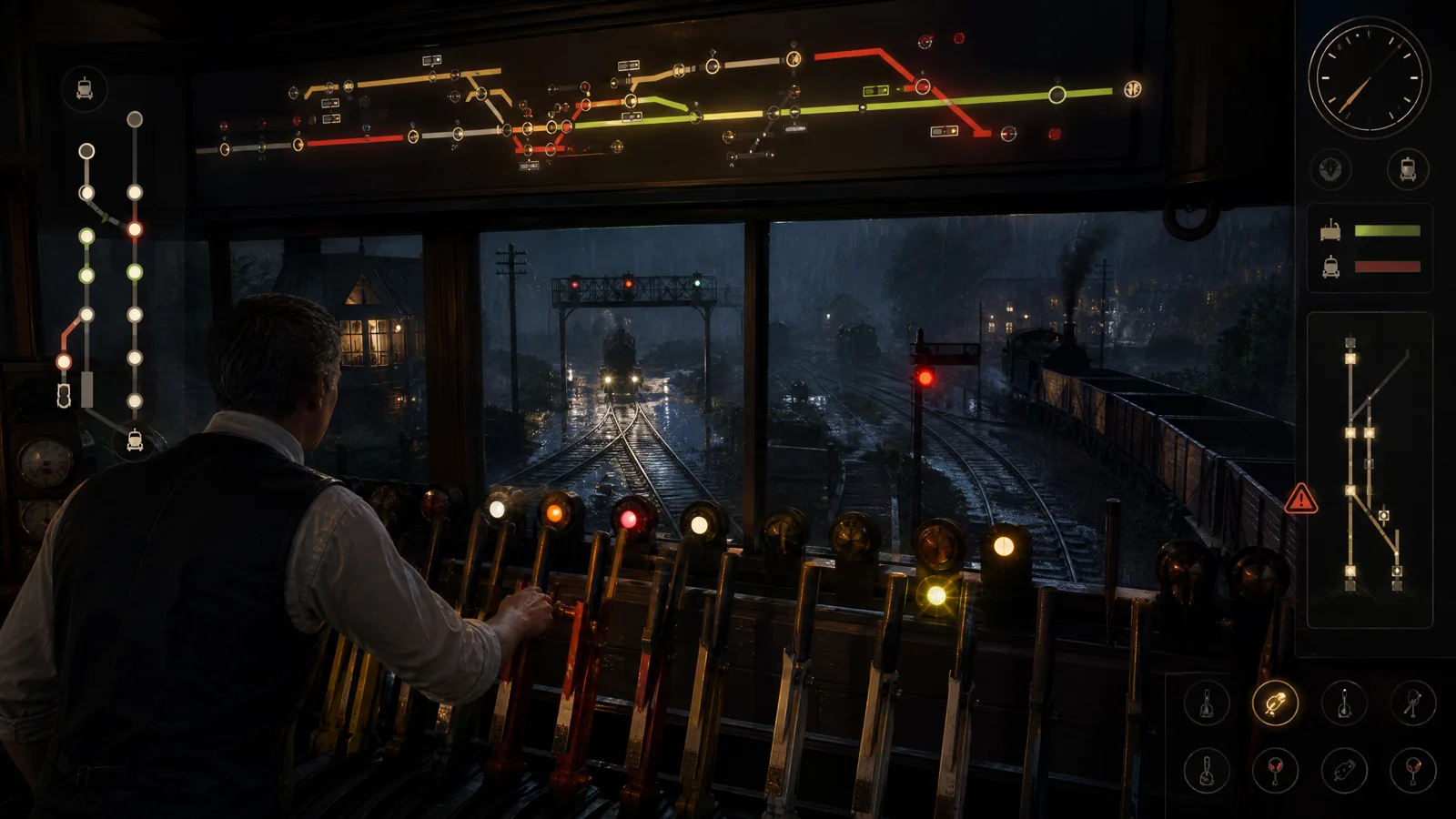
On long afternoons, when rain drums on the roof of a historic box and the world outside drifts into fog, Signal Box Seven invites you to measure time by the weight of a lever and the certainty of a safe headway. This is not a shooter, not a sprint, but a patient tug-of-war with trains that want to be somewhere else and a timetable that wants you to be precise. The game's essence sits in steps: set routes, lock them, watch occupancy blocks settle, respect priority, recover from fault, then wait for the signals to align with progress. It is a quiet kind of thrill, and getting every train home becomes a humane achievement rather than a score.
Inside the box
From the doorway, the box feels almost musical: a wall of brass levers glinting in low amber light, each tied to a tiny lamp that glows green when a route is safe and red when it's not. A large track diagram dominates the opposite wall, ink-lines crisp as a railway map from a Victorian timetable. The glass panes are streaked with rain; outside, the Wetford junction is a tangle of rails and signals, a storm of metal and rain. In the game, you inhabit this space as much as you pilot a timetable as you do a sequence of mechanical interlocks. The art direction leans into tactile realism: the wood grain in the bench, the weight of the lever handles, the hiss of a compressed-air relay when a line is cleared. The first time a train threads its way through a green signal and a locked route, you feel a small, almost domestic triumph: a seam of order stitched into chaos.
Controls, levers and logic
Setting a route begins with choosing the correct lever. Flip it, and a damp metal click confirms the interlock. The route locks, and the diagram breathes—blocks turn from amber to green as occupancy is cleared of conflicting trains. Signals ahead respond with a measured tick, not a blink, telling you that you hold a corridor through a busy junction rather than merely hoping for luck. The timetable imposes a quiet discipline: trains that are listed early in the sequence get priority when conflicts arise, so your decisions ripple outward like a small chain-of-custody through the railway.
Managing multiple trains means reading the diagram as you would read weather: you learn where fog will form, where rain reduces braking distance, and where a minor misalignment could cascade into delays. The levers are not only controls; they are a memory device: you recall which routes you have locked, which sensors are active, and which blocks are flagged for maintenance. The sound design reinforces this: a clean, decisive clack when a lever settles, a low rumble if a route is faulted, a soft ping when an occupancy block slides from occupied to clear.
Timing, blocks and timetable priority
Every move is tethered to a timetable. The player is constantly balancing the immediate safety of a single signal with the longer arc of the day’s schedule. The system models headways as a series of blocks; a train’s approach to the next block is only permitted if it can actually proceed without breaching the safe margin. When two trains would conflict on a junction, priority goes to the one with earlier scheduled time, unless an override is permitted by a deliberate recovery sequence. The result is a tense but comprehensible calculus: you pace the traffic by locking routes only when you can sustain them, you release them just as trains approach, and you watch the timetable queue shift in real time.
What the game communicates well is that this is not a heroic battle but a choreography of caution. To aid you, the on-screen diagram highlights the exact block your current movement will occupy and shows the predicted overlap, if any.
- Route locking prevents conflicting movements by interlocking routes as soon as a lever is thrown.
- Occupancy blocks reflect sections currently occupied or reserved, turning the diagram red or amber and then green as trains clear.
- Timetable priority enforces schedule order; early turns in the day win conflicts, preserving the logic of a real network.
- Manual levers require attention to tactile feedback; mistakes trigger fault states that you must recover from.
- Fault recovery is a deliberate sequence to restore safe operation after a sensor or signal fault.
- Safe headways become a practical, visible constraint rather than a vague ideal.
Aesthetics, sound and user interface
The visuals lean into a late-Victorian functionalism: brass levers, chalk-dust on the walls, a map pinned with old photographs. The palette is muted browns and dull greens; rain on the glass adds streaks that shift with the light as you lean toward different signals. The UI merges with the real world: the track diagram glows with a soft green when a route is ready, amber when it's not yet safe, and red when blockers persist. The audio matches: a chorus of relay clicks, distant whistle on approach, and the rain’s percussion keeping tempo with your actions. The balance between atmosphere and clarity is careful, not theatrical; you always know what your lever has done, and what the next signal will require.
Level design reinforces geographic logic: several junctions mirror real constraints of a small, prefabricated box, so you learn the geography not as abstract puzzle pieces but as a lived layout. The result is a sense of place that helps you stay calm under pressure and remember the correct sequence from one run to the next.
Final judgement
Signal Box Seven is not a grand futurist simulator; it is a patient, humane puzzle that uses a historic control room to teach modern discipline. It rewards precision over speed, attention over bravado, and care for the people whose journeys depend on a well-orchestrated timetable. If you enjoy the tactile satisfaction of a correctly interlocked route, the moment when a red glow yields to green, and the soft exhale after a fault is cleared, you will find that the game folds you into its rhythm without apology. The faults are navigable, the headways legible, and the timetable believable enough to feel like a living network rather than a flat abstract constraint. Its one true achievement is to make the act of getting every train home feel like a quiet ceremony rather than a victory lap.