
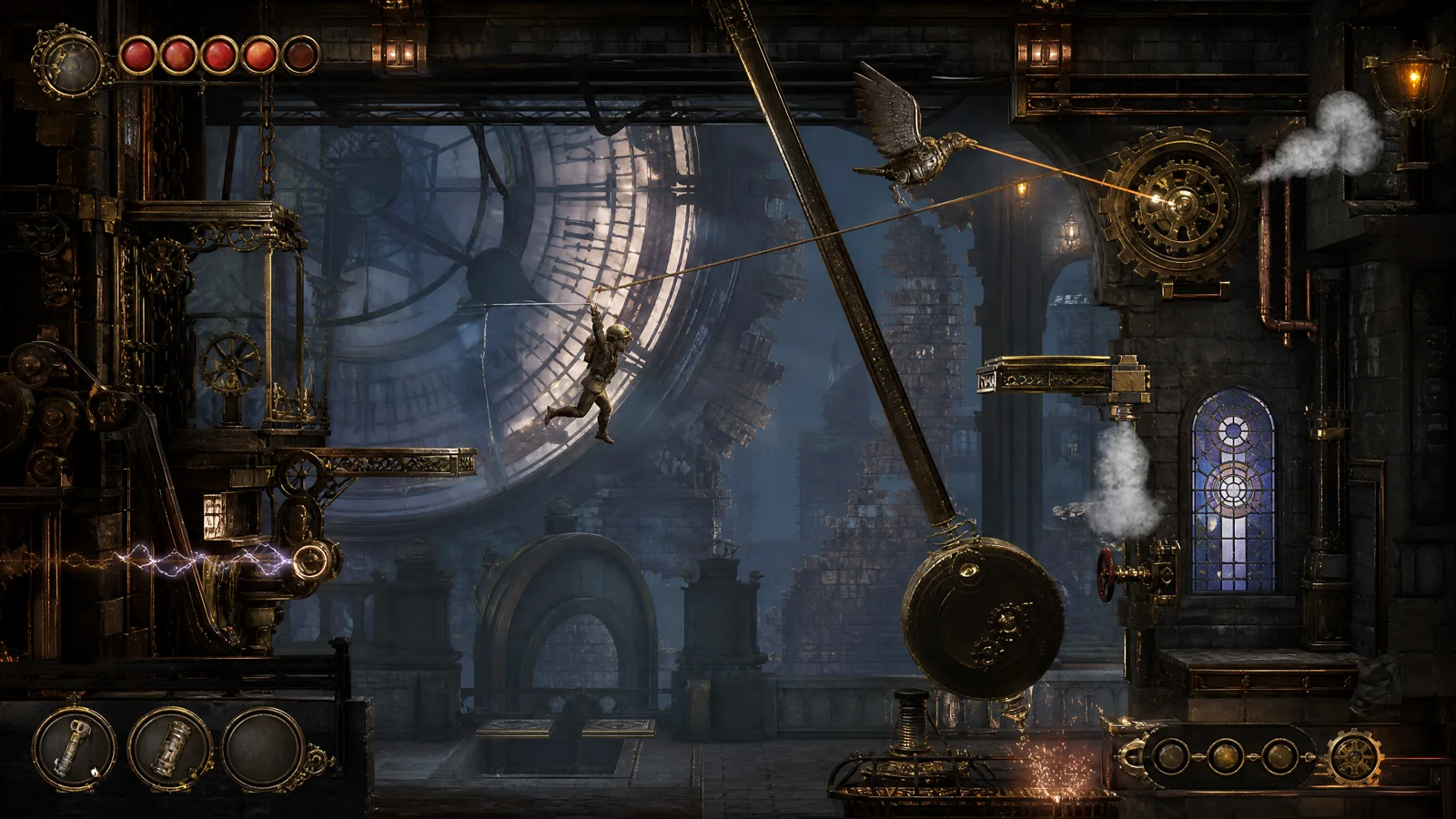
In an era where puzzle platformers often rely on punishing precision or opaque logic, Wren & Wire constructs an environment that communicates entirely through its own mechanics. Set within the cavernous, brass-lined interior of a colossal clock tower, this side-view steampunk adventure is a masterclass in architectural storytelling. The game eschews explicit tutorials, trusting its players to interpret the rhythmic clanking of gears, the hiss of steam valves, and the visual language of its intricate machinery. By pairing an agile engineer with a versatile mechanical avian companion, the experience weaves movement and puzzle-solving into a satisfying tapestry.
The Architecture of Instruction
The true brilliance of Wren & Wire lies in its level design, which serves as both the obstacle and the instructor. The clock tower is not merely a backdrop; it is a sprawling, interconnected organism of brass and copper. Every moving platform, rotating cog, and steam vent operates on a discernible rhythm. When you first enter a new chamber, the environment seems chaotic. However, observation quickly reveals the underlying order. The developers have meticulously tuned the audio-visual feedback so that each mechanism announces its function before you interact with it. A heavy, rhythmic thud indicates a slow-moving counterweight, while a high-pitched whistle warns of an impending steam pressure release.
This approach to environmental teaching is incredibly effective. Rather than pausing the action to explain a new mechanic, the game introduces concepts in safe, isolated scenarios before gradually layering them into complex navigational challenges. The visual language is equally clear. Handholds and grapple points are subtly highlighted by the natural wear and tear of the brass, drawing the eye without breaking the immersion. It is a world built to be read, rewarding players who take a moment to listen and observe before they leap into the void.
Momentum and the Grapple Cable
At the core of the protagonist’s traversal toolkit is the grapple cable, a fluid and versatile mechanic. Unlike the rigid, linear grappling hooks found in many contemporaries, the cable in Wren & Wire is subject to realistic physics. Swinging across a chasm requires a nuanced understanding of momentum and trajectory. The analogue stick controls the length of the cable mid-swing, allowing for precise adjustments to avoid hazards or reach distant ledges. The sensation of releasing the cable at the perfect apex, sailing through the air, and catching a narrow platform just as a massive gear rotates out of the way is consistently exhilarating.
The controls are tight and responsive, which is essential given the precision required in the later stages. The engineer’s movements feel grounded, with a satisfying weight that emphasises the physical exertion of navigating such a hostile environment. This weightiness makes the moments of airborne grace all the more impactful. The interplay between the grapple cable and the moving platforms creates a dynamic rhythm, transforming static puzzles into kinetic set-pieces.
The Mechanical Bird and Co-operative Logic
The engineer is not alone in this towering labyrinth. Accompanying you is the titular Wren, a mechanical bird that serves as an extension of your own capabilities. The bird commands are integrated seamlessly into the control scheme, allowing you to direct the avian automaton to interact with out-of-reach mechanisms. Sending Wren to activate a distant gear while you simultaneously swing across a gap requires a satisfying level of coordination. The puzzles frequently demand this kind of dual-focus, challenging you to manage your own movement while positioning Wren to trigger essential switches or block steam vents.
What elevates this dynamic is the tangible connection between the two characters. Wren is not just a tool; the mechanical bird has its own distinct animations and audio cues, chirping metallic confirmations when a command is received. The puzzles built around Wren’s abilities are some of the most inventive in the game, requiring spatial awareness and precise timing. The satisfaction of executing a flawless sequence, where engineer and bird work in perfect tandem to dismantle a complex environmental lock, is immense.
- Grapple Cable: Physics-based swinging that demands an understanding of momentum.
- Bird Commands: Seamless integration of the mechanical avian companion.
- Steam Pressure: Environmental hazards that require precise timing to navigate.
- Moving Platforms: Rhythmic mechanisms that form the foundation of traversal.
Timing Windows and Safe Resets
Despite the inherent danger of swinging above bottomless pits of grinding machinery, Wren & Wire is remarkably forgiving in its structure. The game employs a system of safe puzzle resets that respects the player’s time. Failing a complex sequence does not result in a tedious trek from a distant checkpoint; instead, the game swiftly resets you to the beginning of the immediate challenge. This encourages experimentation and bold manoeuvres, removing the frustration that often plagues the genre. You are free to test the limits of the grapple cable and experiment with Wren’s commands without the fear of severe punishment.
The timing windows for interactions and jumps are strict but fair. The game demands precision, but it always provides the necessary information to succeed. When you miss a jump or mistime a swing, it is almost always clear why it happened. The audio-visual cues are so reliable that failure feels like a miscalculation on your part, rather than an arbitrary punishment from the game.
Gears that Grind
For all its mechanical elegance, the game is not entirely without friction. While the environment is visually striking, the reliance on a single clock tower setting can lead to a sense of visual fatigue in the latter half of the adventure. The brass, copper, and steam aesthetic is beautifully realised, but a greater variety in colour palettes or architectural styles within the tower would have been welcome. There are moments when the intricate background details blur into the foreground mechanisms, occasionally making it difficult to distinguish interactive elements from pure decoration during fast-paced sequences.
Furthermore, while the safe reset system is a blessing, a handful of the late-game puzzles suffer from a slight over-reliance on trial and error. In these instances, the environmental cues are perhaps a bit too subtle, requiring a few failed attempts to fully grasp the intended solution. These moments are infrequent, but they stand out precisely because the rest of the game is so exceptionally good at communicating its logic organically.
Final Judgement
Wren & Wire is a triumph of environmental design and mechanical cohesion. It transforms a colossal clock tower into a sprawling playground of kinetic puzzles and physics-based traversal. The interplay between the weighty grapple mechanics and the co-operative logic of the mechanical bird creates a deeply engaging rhythm. By teaching its systems through observation and feedback rather than explicit instruction, it fosters a profound sense of discovery and mastery. Despite minor issues with visual variety and a few opaque late-game puzzles, it stands as a shining example of how architecture and movement can intertwine to create a truly memorable platforming experience. It is a mechanism finely tuned, rewarding those who are willing to learn its rhythm.